A light-emitting diode (LED) is a semiconductor device that converts electric current directly into light. It consists of a semiconductor crystal, a housing with contact wires and an optical system.
Up to a point, yes. The higher the current, the more electrons and holes enter the recombination zone per unit of time. But current cannot be raised indefinitely: resistance in the semiconductor and in the p-n junction turns the surplus into heat, and the diode overheats and fails.
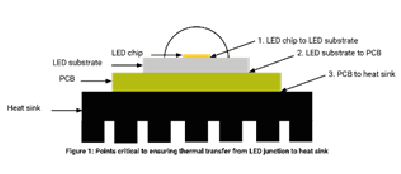
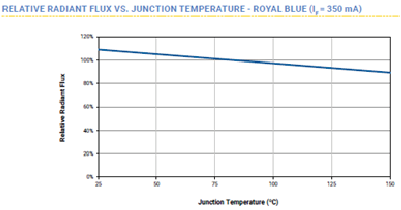
Two temperatures matter, and they govern different things: the temperature at the crystal surface determines lifetime, while the temperature at the p-n junction determines luminous flux. As junction temperature rises, internal quantum efficiency falls because of vibrations in the crystal lattice, so the LED dims. This is why heat dissipation sits at the centre of luminaire design.
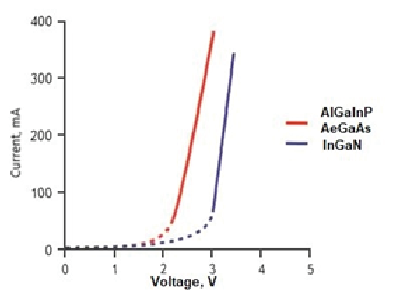
In the operating range, current depends exponentially on voltage — a small change in voltage produces a large change in current. Because luminous flux is directly proportional to current, unstabilised current means unstable brightness. Current above the permitted limit also overheats the LED and accelerates its ageing. An LED driver stabilises the current flowing through the LED.
LEDs are often described as almost indestructible, which overstates it. The more current passing through an LED, the hotter it runs and the faster it ages. Ageing shows first as falling brightness — an LED is treated as spent once output has dropped by 30 % or by half, depending on the application. Colour shifts as well as dims, and there is still no agreed standard for quantifying that colour change or comparing it against other sources.

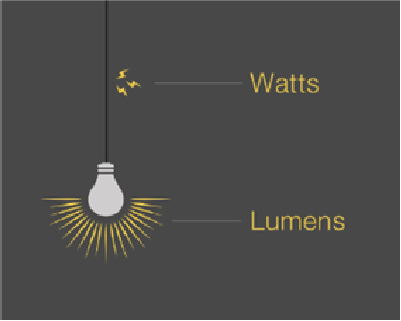
Our most efficient series reaches more than 176 lm/W, and every series is quoted at a stated load rather than a best case — each figure in the series specifications names its load. Higher efficacy means fewer luminaires for the same illuminance, and that saving repeats every hour the installation runs.
Depending on the series, our luminaires operate from −40 °C to +50 °C and are rated IP54 to IP66. The LEDs are Cree or Lumileds and the drivers are Mean Well or Lifud. Every series carries a five-year warranty, with seven years on PRO versions.
Every series ships with its Declaration of Conformity, a datasheet and a technical appendix. Photometric IES files are published for each series, so a luminaire can be modelled in DIALux or Relux before anything is ordered. Colour temperatures from 2700 K to 6500 K are available across the range.

Ledmada UAB
Registration code 303287697
VAT code LT100008526416
P. Lukšio g. 6 / Kalvarijų g. 125, 3 korpusas
LT-08221 Vilnius, Lithuania
Email info@ledmada.lt
Tel. +370 653 88885
IBAN LT94 7300 0101 3894 9797
Bank Swedbank AB / SWIFT HABALT22